


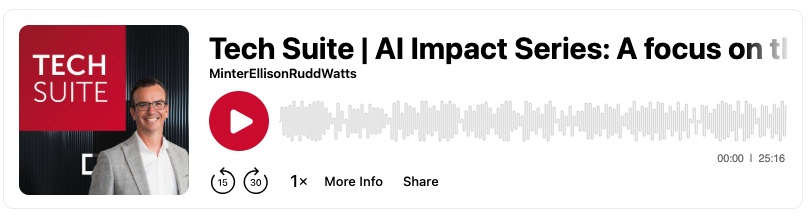
In this episode, Technology partner Tom Maasland speaks with Maria Mingallon, Regional Knowledge and Information Manager and Digital AI Lead at Mott MacDonald (Asia, Pacific, New Zealand and Australia) about how AI is reshaping the architecture, engineering, and construction (AEC) sector.
[01:28] Tom and Maria discuss current examples of AI technologies utilised by the AEC sector, such as predictive modelling, computer vision for safety compliance, optical character recognition for digitisation, and AI-powered drones for infrastructure projects, which analyse structural data through both visual and acoustic sensors, enabling early detection of potential defects.
[05:35] Tom asks Maria about the impact of the rollout of Microsoft Copilot 365 at Mott MacDonald. Maria outlines strategic considerations behind its adoption, including a user selection process via expressions of interest as well as prompt engineering and governance training to ensure responsible AI use. She highlights productivity KPIs indicating a 4.3% efficiency gain across a 40-hour work week. She also shares examples of how it has enhanced productivity in areas such as bid preparation, summarisation of key data, and advanced Excel analysis by engineers.
[10:40] They discuss sector-wide challenges to AI adoption in the AEC industry like lack of trust, slow development of governance structures, and limited shared visibility into AI tool usage, with efforts underway to compile case studies and promote transparency.
[13:12] Maria highlights additional challenges, including a systemic tendency within the AEC sector to build rather than buy AI tools, a lack of clear long-term project pipelines, and the critical need to overcome these challenges by developing robust AI strategies and effective governance structures, and investing in upskilling across teams.
[19:28] Maria shares her insights on AI’s evolving role in the AEC sector, observing that while AI will liberate humans from completing repetitive tasks, it will simultaneously amplify the need for human creativity, critical thinking, and intentional leadership. She underscores the importance of staying curious, using AI thoughtfully, and fostering cross-industry collaboration.
[21:58] Tom and Maria discuss the potential for shared AI innovations across the sector, such as the development and use of digital twins.
For more information on the AI Forum and their AEC Working Group, visit their website here.
Information in this episode is accurate as at the date of recording, 12 May 2025. Originally published on Minter Ellison’s website.
Key takeaways
-
Real-world AI examples: predictive modelling, computer vision for safety compliance, OCR for digitisation, and AI-powered drones that combine visual and acoustic sensing to detect potential structural faults early.
-
Enterprise deployment story: Mott MacDonald’s rollout of Microsoft Copilot 365 involved:
-
Expression of interest selection process,
-
Prompt engineering training,
-
Responsible AI governance.
Early results indicate productivity improvements equating to ~4.3% of a 40-hour work week. Use cases include bid preparation support, summarising data, and advanced Excel analysis for engineers.
-
-
Sector-wide adoption challenges:
-
Trust and governance are lagging adoption rates.
-
Limited visibility on tool usage across firms slows scaling.
-
Tendency in the sector to “build rather than buy” solutions increases risk and cost.
-
Lack of long-term project pipelines and limited upskilling investment are barriers.
-
-
Strategic emphasis:
-
AI will free teams from repetitive tasks but simultaneously increase demand for human creativity, critical thinking, and leadership.
-
Effective AI strategies must combine technology, governance, upskilling, and cross-industry collaboration to realise the full benefits.
-
-
Future opportunities:
-
The conversation touches on how innovations like digital twins could be leveraged collaboratively across the sector to improve planning, execution, and lifecycle management of built assets.
-